Fancy Blue Diamonds For Engagement Rings
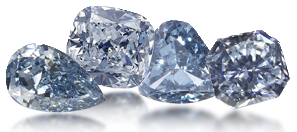
Natural Fancy Blue, Color-Enhanced Blue, and Lab Created Blue Diamonds
The powerful color of the sea and the sky meet in these exceptional gems. Fancy blue colored diamonds are scarce, and each shade is exquisite. They range from very light shades to a steel-blue hue.
Natural blue diamonds derive their color from boron impurities. Because of boron, some blue diamonds can conduct electricity!
There are three types of blue diamonds you can choose for your custom ring, which are mentioned below.
Natural Fancy Blue Diamonds

Natural blue diamonds usually show a hint of gray or sometimes green, thus making the pure blue the true Cinderella's slipper of diamonds.
PRICING OF NATURAL BLUE DIAMONDS: While we often get requests for natural blue diamonds, these diamonds are rarer than one might imagine. A fine 1-carat blue diamond can be worth hundreds of thousands of dollars.
For an affordable blue diamond, your best options are color-enhanced natural blue diamonds, which are more saturated in tone, or lab-created blue diamonds, which have natural color yet are still rare.
Color-Enhanced Natural Blue Diamonds

Color-enhanced blue diamonds start in the earth. They are earth-grown and mined, just like a natural fancy colored diamond. Unlike its rare cousin, however, the color-enhanced diamond undergoes a treatment that changes its tone. This is a permanent and internal treatment; it is not a coating.
Color-enhanced blue diamonds are not available in light pastel tones. They have deep, rich colors with a green undertone, giving them a sparkly, turquoise-ocean feel.
PRICING OF COLOR-ENHANCED BLUE DIAMONDS: These diamonds are very close in price to natural white diamonds, and sometimes are even a little less. It depends primarily on the desirability of the color: lighter blue diamonds will be the most expensive, while the darker, more saturated tones are often more affordable than a white.
Lab-Created Blue Diamonds

Lab-created blue diamonds are grown in a laboratory, not in the earth. They are molecularly identical to natural diamonds; therefore, they have the same hardness and internal characteristics as natural diamonds.
The blue color of a lab-created diamond is more natural than the color of a color-enhanced blue diamond.
Although availability remains limited, the colors range from very light blue to medium blue, all within the natural blue hues found in earth-created blue diamonds.
Blue Diamond History Trivia

The Cullinan mine near Pretoria, South Africa, is the world's only notable producer of blue diamonds. The mine also produced the largest diamond in the De Beers Millennium Jewels collection — the brilliant, vivid blue Heart of Eternity, weighing 27 carats.
The Hope Diamond, arguably the most famous diamond in the world, is a natural fancy blue diamond, weighing 45 carats. It was brought from India to Europe in the 17th century, when it was still known as the Tavernier Blue, and sold to King Louis XIV of France. It came to be considered bad luck for its subsequent possessors, including Marie Antoinette. This deep blue diamond is now displayed at the Smithsonian Institute in Washington, DC.
The largest blue diamond is the Idol's Eye, weighing 70.21 carats. It made its first public appearance at a Christie's auction in London in 1865.
Let Krikawa Find the Perfect Blue Diamond for your Engagement Ring
